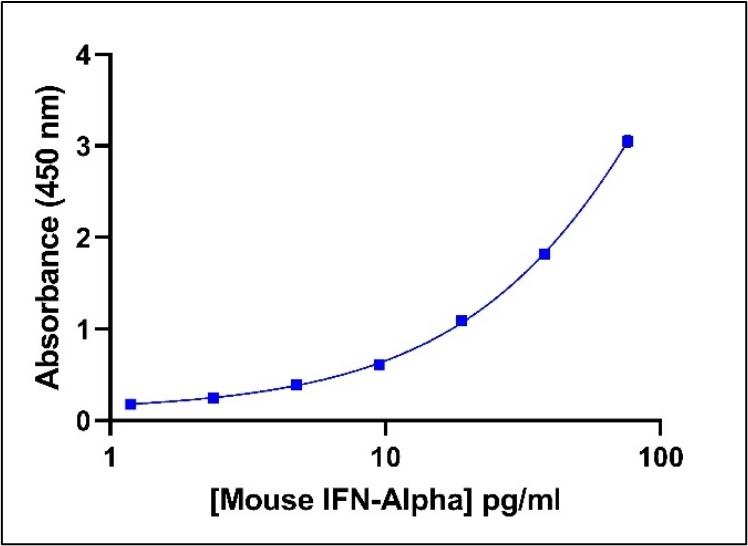
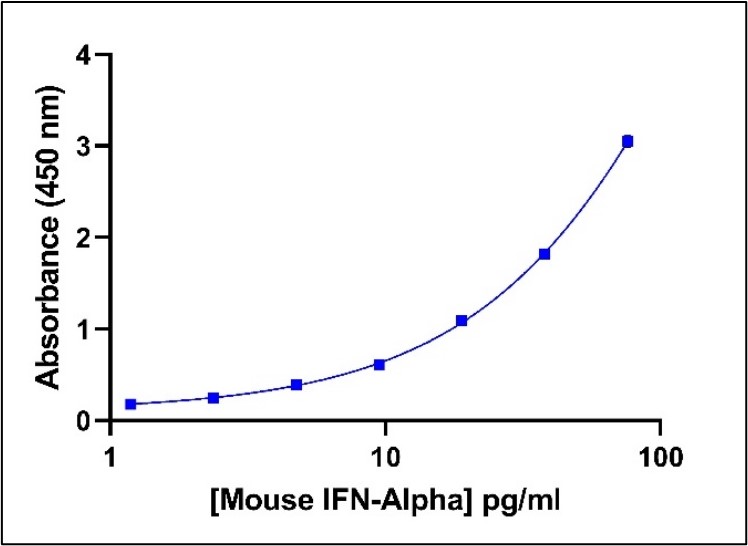
This Mouse Interferon Alpha ELISA has an LLOQ of 2.38 pg/ml and can detect all 14 mouse IFN-Alpha subtypes in serum, plasma, and tissue culture media. This ELISA provides total IFN-Alpha readout in approximately 2 hours.
The VeriKine-HS Mouse IFN-Alpha ELISA kit has been developed to quantitate low levels of IFN-Alpha in mouse serum, plasma and cell/tissue culture media (10% FBS) using a sandwich immunoassay. The kit contains an anti-mouse IFN-Alpha detection antibody conjugated to biotin and quantified by streptavidin horseradish peroxidase (HRP) using tetramethyl-benzidine (TMB) as a substrate.
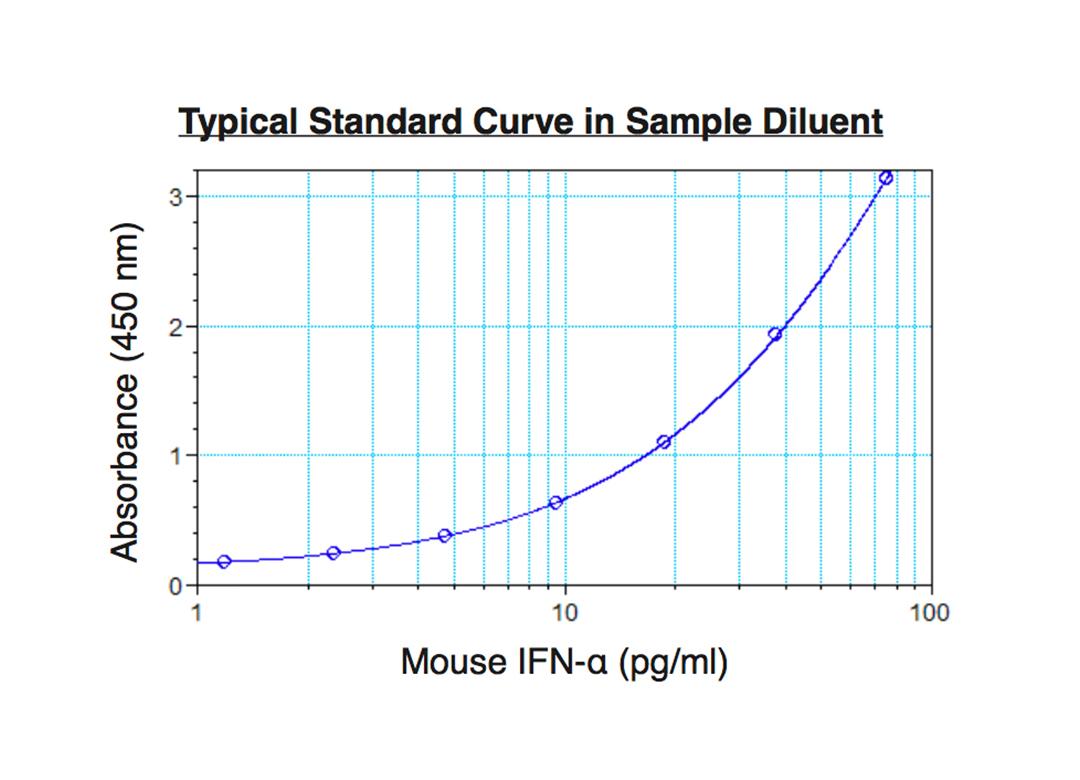
The kit standard is mouse IFN-Alpha 4 protein. It is important to run the standard curve in the same matrix as one’s samples unless one has demonstrated that the matrix does not significantly affect the signal.
Documentation
Protocol, Certificate of Analysis (CoA), Technical Data Sheet (TDS), Safety Data Sheet (SDS)
IFN alpha, IFN-Alpha, Multisubtype Interferon Alpha, alpha interferon, Type I interferon, IFN-α
Storage
2-8°C
Expiration Date
One year from the date of manufacture
Shipping Condition
Wet Ice
Materials Provided:
Pre-coated microtiter plate
Plate Sealers
Wash Solution Concentrate
Mouse IFN-Alpha 4 Standard, 10,000 pg/ml
Sample Diluent
Antibody Concentrate
Antibody Diluent
HRP Conjugate Concentrate
HRP Diluent
TMB Substrate Solution
Stop Solution
Additional Materials Required (Not Provided)
Microplate reader capable of reading an OD at a wavelength of 450 nm
Variable volume microtiter pipettes
Adjustable multichannel pipette (50-300 μl)
Reagent reservoirs
Wash bottle or plate washing system
Distilled or deionized water
Serological pipettes (1, 5, 10 or 25 ml)
Disposable pipette tips (polypropylene)
Plate shaker
Representative Mouse IFN-Alpha Standard Curve in Sample Diluent
Intra and Inter-Assay CVs to measure Precision
Concentration (pg/ml)
Endogenous Level
Low
Medium
High
Intra-Assay CV (%)
4.4
3.3
2.8
Inter-Assay CV (%)
7.8
5.8
8.7
Spike Recovery
Dilution
Average Concentration (pg/ml)
% Linear Adjusted Dilution
Not Adjusted for Dilution
Adjusted for Dilution
2
39.5
79.1
-
4
19.1
76.6
96.8
8
9.7
77.3
97.8
16
4.9
78.8
99.7
32
2.5
80.7
102.0
64
1.2
77.7
98.2
Avg
-
78.4
98.9
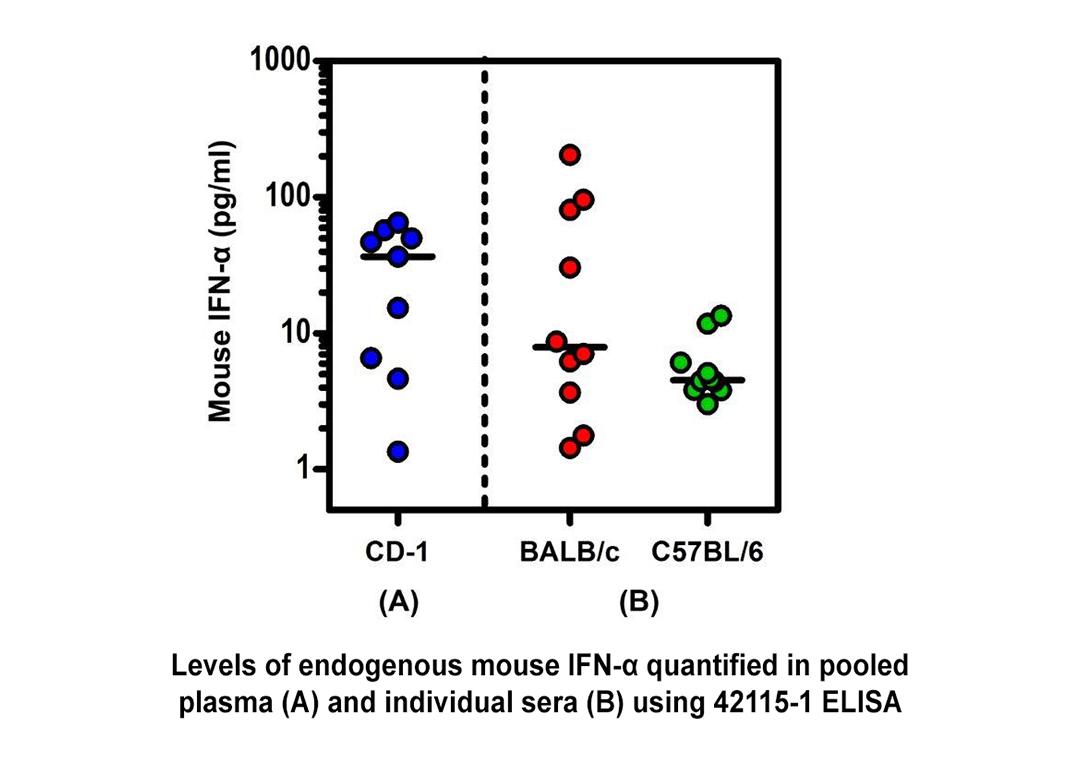
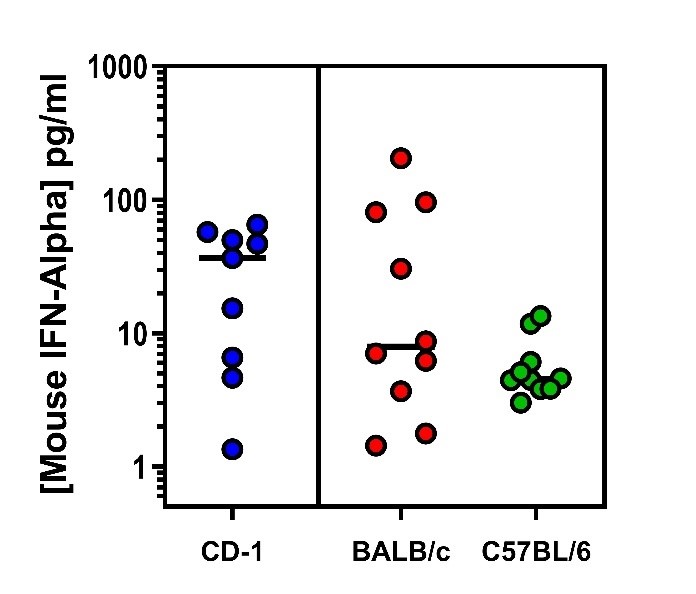
Endogenous Mouse IFN-Alpha Quantified in Plasma or Serum From Three Mouse Strains Using PBL’s High Sensitivity Mouse IFN-Alpha All Subtype ELISA
Total endogenous levels of mouse IFN-Alpha were quantified in pooled plasma (blue, left) and individual sera (red and green, right) for three mouse strains: CD-1, BALB/c, and C57BL/6. Results from this experiment led to the recommendation to pre-screen serum, as a significant portion of samples contain quantifiable levels of endogenous interferon alpha.
Background
Interferons (IFNs) are an extensive set of cytokines exhibiting pleiotropic activities and playing major roles in both innate and adaptive immunity. The Type I IFNs genes consist of multiple IFN-Alpha genes, at least one IFN-Beta gene in most vertebrates, and a few other family members including limitin in the mouse and IFN-Omega and -Epsilon in mice and humans. In the mouse, fourteen (14) IFN-Alpha genes have been cloned which exhibit at least 75% identity at the protein level. In the therapeutic setting, IFN-Alpha is used to treat viral diseases and certain cancers and is therefore frequently studied in mouse and other animal models of these diseases. Several lines of evidence indicate that IFN-Alpha proteins may be involved in the development of specific autoimmune diseases and that treatment with IFN-Alpha blocking antibodies may comprise a useful therapeutic strategy.
The expression of interferon genes (and therefore, proteins) is regulated by a group of interferon regulatory factors, i.e., the IRF family of proteins. Cellular levels of IRF3 and IRF7 regulate the expression of individual IFN-Alpha subtypes with most IFN-Alpha subtype genes requiring IRF7 for expression. IRF7 protein is either constitutively expressed or inducible, depending on cell type. In certain mouse cell lines, IRF7 expression is induced in particular by at least IFN-Beta and IFN-Alpha4 which then leads to expression of the other IFN-Alpha subtype genes. Additionally, murine IFN-Beta may be requisite for fibroblast synthesis of IFN-α but may not be required for other cells’ synthesis of IFN-Alpha. The IRF3/IRF7 signaling cascade is a focal point for initial and progressive cellular responses to pathogens where hundreds of genes are subsequently regulated in a temporally coordinated cascade.
Plasmacytoid dendritic cells (PDCs) are highly efficient producers of IFN-Alpha, but a wide variety of cells can also produce lower levels of these protein subtypes. The particular IFN-Alpha subtype genes that are expressed appear to be somewhat cell and stimulus-specific and, based on the results published from several gene induction studies, the time courses of induction of the individual protein subtypes are expected to differ markedly.
This Mouse Interferon Beta ELISA has an LLOQ of 0.94 pg/ml and is compatible with serum, plasma, and tissue culture media (TCM). Product Name: VeriKine-HS Mouse Interferon-Beta ELISA Kit
This well-cited TCM-compatible ELISA detects all 14 mouse IFN-Alpha subtypes to an LLOQ of 12.5 pg/ml. This immunoassay is based on the international reference standard for mouse IFN-Alpha.
Product Name: VeriKine Mouse Interferon-Alpha ELISA Kit (TCM)
 Powered by Bioz