
Why p-tau217?
Alzheimer’s disease (AD) remains one of the most challenging neurodegenerative disorders to diagnose and treat effectively. As researchers have tried to untangle the complexities of the disease, including the accumulation of amyloid-beta plaques and tau tangles, recent discoveries have pointed to a critical biomarker: phosphorylated tau 217 (p-tau217). This particular form of tau holds promise as a transformative element in AD research, potentially reshaping diagnosis, understanding, and treatment.
What is Tau, and Why Does It Matter?
Tau is a protein integral to the brain's microtubule system, primarily responsible for maintaining cellular stability, especially within neurons. Microtubules act as scaffolding within neurons, enabling intracellular transport of nutrients and other molecules. Tau stabilizes these structures by binding to microtubules, ensuring that neurons function properly.(1) In normal conditions, the phosphorylation (addition of phosphate groups) and dephosphorylation (removal of these groups) of tau proteins are tightly regulated by enzymes. When this regulation fails, tau can become hyperphosphorylated, leading to structural and functional consequences within neurons.
In AD, tau becomes hyperphosphorylated and loses its affinity for microtubules and detaches, beginning a harmful process. Over time, p-tau aggregates within neurons, adopting a toxic beta-sheet structure and eventually forming paired helical filaments. These filaments coalesce into tau tangles(2) —distinct, neurotoxic structures that disrupt cellular functions, impair neuronal communication, and, ultimately, lead to cell death.
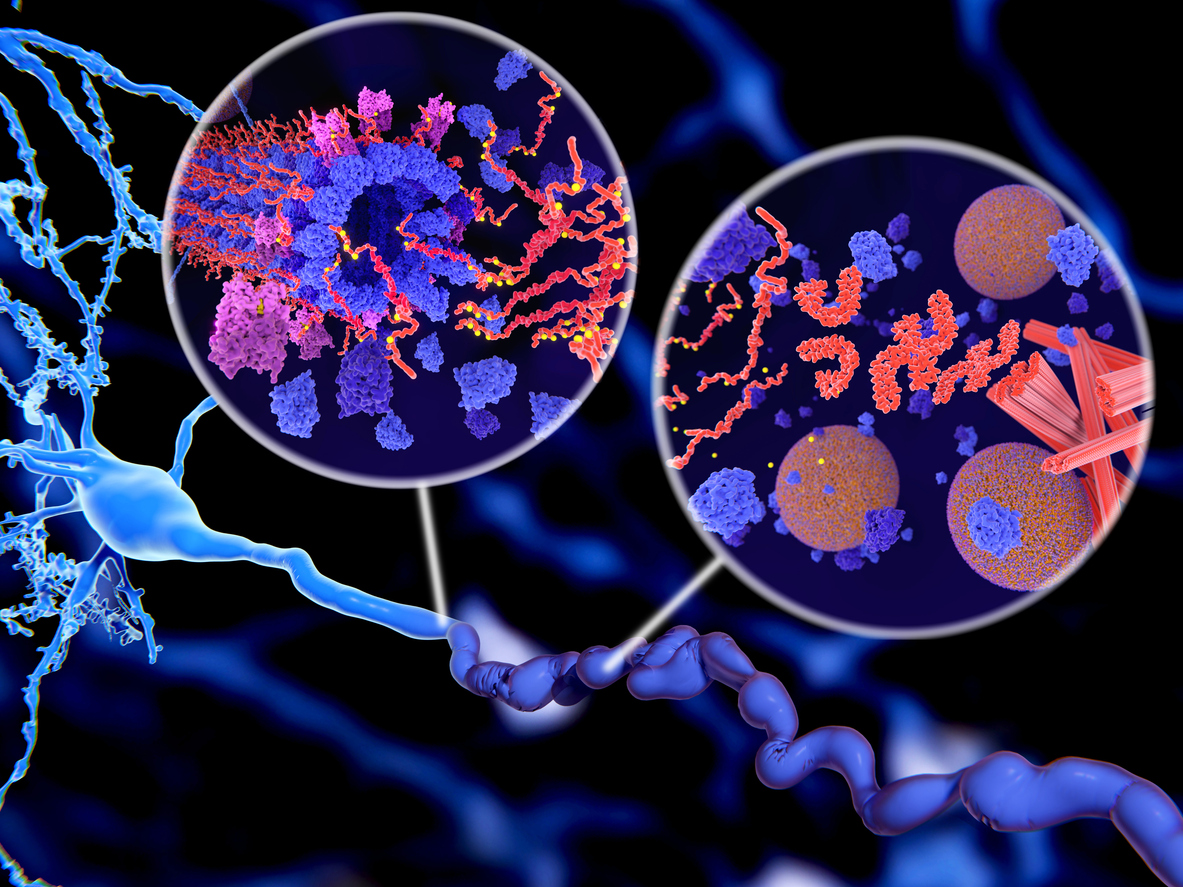
Alzheimer's disease. Pathological Tau protein (red-orange) phosphorylation (yellow) leads to disintegration of microtubule and aggregation to neurofibrillary tangles (orange) in a neuron axon. The transport of synaptic vesicle (spheres) is disrupted.
The Spread of p-tau in Alzheimer's Disease
One of the defining characteristics of p-tau in Alzheimer’s disease is its prion-like behavior, where misfolded tau proteins can "seed" neighboring cells, promoting further aggregation. This spread is believed to follow a specific pathway across brain regions, from the entorhinal cortex (one of the earliest sites of accumulation) to other areas crucial for memory and cognition, including the hippocampus and cortex. Research suggests this spread occurs through mechanisms where misfolded proteins propagate to healthy proteins, corrupting their structure. The transmission of misfolded tau is not fully understood, but it likely involves cellular transport mechanisms such as endocytosis or exocytosis, whereby p-tau is released into extracellular space and subsequently taken up by neighboring cells. Once internalized, p-tau could seed tau aggregation in the recipient cell, creating a domino effect across neural networks. Notably, this prion-like spread aligns with clinical symptoms, correlating with progressive cognitive decline and memory loss in individuals with AD. In addition to spreading from cell to cell, p-tau appears to act through multiple pathways, impairing normal brain function by disrupting cellular processes.(1)
Unlike amyloid-beta (Aβ) plaques, which accumulate outside of cells, tau tangles form within neurons, presenting unique challenges in targeting and removing these structures. As AD progresses, p-tau levels rise in cerebrospinal fluid (CSF) and blood, directly correlating with brain atrophy and cognitive decline. While Aβ plaques appear early in AD and may initiate some of the disease processes, tau pathology is more directly linked to cognitive symptoms. This connection has led to the amyloid hypothesis, suggesting that Aβ plaques might trigger tau aggregation, fueling neurodegeneration. Some experts propose that tau aggregation can occur independently of Aβ, as seen in diseases like frontotemporal lobar degeneration (FTLD), indicating that tau itself plays a critical role in AD.
P-tau217: Why This Biomarker?
While several forms of phosphorylated tau have been studied as potential biomarkers, p-tau217 has garnered attention due to its high specificity for Alzheimer's disease:
- Diagnostic Accuracy: p-tau217 can reliably distinguish AD from other forms of dementia.(3)
- Disease Specificity: It is specific to AD pathology, unlike other tau variants that may appear in various neurodegenerative diseases.(3)
- Correlation with Other Biomarkers: p-tau217 aligns closely with other AD markers in PET imaging and CSF analysis.(4)
- Predicative Power: p-tau217 is effective in predicting the onset of AD dementia, even in those with mild or no cognitive impairment.(4)
For years, the CSF Aβ 42/40 ratio has been a gold standard biomarker for AD diagnosis. However, p-tau217 shows superior reliability in blood-based tests by more accurately distinguishing between amyloid-PET-positive and -negative samples. Levels of p-tau217 in the blood of AD patients can increase by as much as 100-400%, emphasizing its relevance for AD diagnosis through non-invasive methods.(3)
What's New with p-tau217 in 2024?
Blood-based assays are rapidly transforming the landscape of AD diagnostics, with companies such as Quanterix® and Meso Scale Discovery® (MSD) developing ultrasensitive assays for measuring p-tau217. By providing reliable and accessible tools for measuring p-tau217 in healthy and disease sera, these advancements hold promise for large-scale screening efforts, leading to identifying at-risk individuals in the general population or within high-risk groups.
One key advantage of blood-based testing is its potential for widespread use, facilitating early intervention and enrollment in clinical trials aimed at preventing or slowing AD progression. Unlike PET scans, which are expensive and not widely available, blood-based tests could be integrated into routine clinical care, allowing for broader access to diagnostic services. Moreover, these blood tests have shown excellent agreement with established biomarkers like the Aβ42/40 ratio, GFAP, and NfL, creating a strong foundation for multi-marker screening protocols that may further enhance our understanding of AD progression and potential diagnostic accuracy.
Meanwhile, researchers have furthered their understanding of how tau tangles affect the brain, with studies suggesting that p-tau217 may contribute to AD through pathways involving disrupted dynamin function and oxidative stress response.
How p-tau217 May Drive Neurodegeneration
Recent research using animal models suggest that p-tau might contribute to neurodegeneration in AD through at least two primary mechanisms:
- Disruption of Dynamin Function: Dynamin is a protein essential for endocytosis, a process that neurons use to internalize molecules and communicate effectively. Tau and dynamin both bind microtubules, and when tau becomes hyperphosphorylated, it loses its affinity for these structures. This detachment allows hyperphosphorylated tau to bind with dynamin, reducing its availability for endocytosis and potentially impairing synaptic transmission. Studies in AD mouse models have demonstrated that a dynamin-derived peptide, PHDP5, can improve learning and memory, suggesting that p-tau’s interference with dynamin may contribute to AD symptoms.(5)
- Oxidative Stress and Lipid Droplet Formation: In neurons, reactive oxygen species (ROS) are naturally produced as byproducts of cellular processes. Excessive ROS, however, can damage cells. Normally, tau helps form lipid droplets to sequester ROS until they can be neutralized by glial cells, thereby protecting neurons from oxidative stress. But in AD, tau mutations or dysfunctions prevent these protective droplets from forming, leading to ROS accumulation and neuronal damage. Animal models with impaired tau-related lipid droplet formation have shown neurodegeneration and motor impairments, which were alleviated by antioxidant treatments, underscoring oxidative stress’s role in tau-related neurodegeneration.(6)
P-tau217 as a Biomarker for Alzheimer's Disease
As of early 2024, two p-tau217 assays—AlzPath and Janssen—have demonstrated strong diagnostic performance, effectively differentiated AD from other neurodegenerative diseases.(4) Both assays showed that plasma p-tau217 concentrations rose with AD severity (Braak staging). Furthermore, both assays correlated with annual changes in PET measures of tau in the cortex.
P-tau217 is not the only type of p-tau associated with atrophy and cognitive decline; p-tau181 and p-tau231 also show correlations. However, a study involving both humans and mice suggests that p-tau217 may play a stronger, specific causal role in AD neurodegeneration. In the study, a specific p-tau217 antibody (mAb2A7) was shown able to halt neural loss associated with apoptosis, reverse cognitive loss, and improved motor function in tauopathy mouse models, whereas another antibody targeting total tau shown similar profile but produced an adverse effect, underscoring the advantage of targeting p-tau217 alone.(6)
Additionally, p-tau217 appears to play a role in mitochondrial dysfunction, which is a hallmark of neurodegeneration. Mitochondria are responsible for energy production in cells, and their impairment leads to reduced energy availability, increased oxidative stress, and, ultimately, cell death. By examining the effects of p-tau217 on mitochondrial function, researchers hope to identify new targets for therapeutic intervention, particularly those that enhance mitochondrial health or reduce oxidative stress in neurons.
P-tau217 as a Predictor of Amyloid Pathology in Cognitively Unimpaired Individuals
P-tau217 is showing remarkable utility not only in predicting disease progression in individuals with mild cognitive impairment (MCI) and Alzheimer’s disease (AD) but also in identifying those who appear cognitively unimpaired but are beginning to show amyloid pathology. This ability to detect early signs of AD is crucial, as it opens the door for earlier intervention and better tracking of disease onset.
Across nine longitudinal cohorts of people without cognitive impairment, plasma p-tau217 and tau-PET scans of the medial temporal lobe were equally effective in predicting global cognitive decline, showing a low-to-moderate predictive power (R2 = 0.32). Plasma p-tau217 was also as effective as tau-PET at predicting progression from cognitive health to mild cognitive impairment.(7)
In a July 2023 study, Jonaitis and colleagues analyzed data from three of these cohorts, focusing on cognitively unimpaired individuals with initially low levels of amyloid-beta (Aβ) in the brain. Notably, plasma p-tau217 alone was highly accurate in distinguishing elevated Aβ levels measured by PET scans, with an AUC (area under the curve) ranging from 0.97 to 0.98. This accuracy remained high even without combining p-tau217 with plasma Aβ42/40. However, when Aβ levels were measured through cerebrospinal fluid (CSF) rather than PET, combining p-tau 217 with plasma Aβ42/40 provided a more accurate prediction.
The authors concluded that blood tests for p-tau217 and Aβ42/40 offer promising tools for identifying individuals with early amyloid pathology for inclusion in longitudinal research and clinical trials.(8)
Blood-Based p-tau217 Testing in Alzheimer's Disease: Reducing the Need for PET Scans and replacing CSF Tests
In 2022, PET scans to detect amyloid-beta and tau pathology, along with CSF measures like the Aβ 42/40 ratio, p-tau, and total tau, were the gold standards for Alzheimer’s diagnosis. However, recent evidence suggests that blood-based measures of p-tau217 should also be considered among these top-tier diagnostics. By late 2023, blood p-tau217 was found to detect amyloid and tau pathology with an accuracy comparable to CSF and PET biomarkers.(2)
In July 2024, the ALZpath p-tau217 blood immunoassay demonstrated performance on par with CSF measures in detecting AD and even outperformed PET measures of brain atrophy in some instances. Across various cohorts, this blood-based immunoassay maintained its reliability and accuracy, making it a promising alternative to more invasive diagnostic tests.(9)
Adding other plasma biomarkers to the analysis significantly reduced the proportion of uncertain cases. At a 2024 AD conference in July, Quanterix reported that combining p-tau217 with amyloid β42, amyloid β40, glial fibrillary acidic protein (GFAP), and neurofilament light (NfL) yielded a risk score that improved AD detection even further than using p-tau217 alone. With this multi-marker approach, the intermediate or uncertain group size dropped from 31% to 11%, underscoring the benefits of a comprehensive biomarker panel.
Technical Challenges in Blood-Based p-tau217 Assays
Despite the advantages of blood-based p-tau217 testing, certain technical challenges remain. Since blood assays for p-tau217 are relatively new, there is no standardized reference procedure, which can lead to test-retest variability. In fact, as of June 2022, variability in repeated tests using the Simoa assay was around 20% for p-tau217, compared to just 4% for plasma Aβ42/40. This discrepancy suggests a need for further refinement in blood p-tau217 assays to ensure consistent results.
Additionally, blood assays often yield a significant proportion of uncertain cases due to low concentrations of analytes in the blood. The rate of uncertain cases for p-tau217 when used alone can be as high as 20%. This level of uncertainty is similar for blood Aβ42/40 and is even lower compared to other biomarkers such as NfL and GFAP. However, the rate of uncertain results can be decreased by including additional biomarkers, as the Quanterix® multi-marker approach demonstrates.(10)
The Future of p-tau217 Testing in Alzheimer's Disease Diagnosis and Research
P-tau217 has emerged as a transformative biomarker in Alzheimer’s research, showing exceptional promise for diagnosing amyloid pathology in cognitively unimpaired individuals, predicting disease progression, and potentially reducing reliance on more invasive CSF and PET measures. Blood-based p-tau217 assays are already proving effective for early diagnosis and clinical trial enrollment, with the potential to become a mainstay in routine AD diagnostics.
Continued research is needed to establish certified reference procedures, enhance assay sensitivity, and ensure reproducibility across labs. Standardizing these assays and integrating additional biomarkers like amyloid β42, amyloid β40, GFAP, and NfL could further increase diagnostic accuracy, making p-tau217 testing a reliable option for widespread clinical use. As AD research progresses, p-tau217 may not only streamline diagnostics but also enable early interventions that could mitigate disease progression and improve patient outcomes.
Targeting Toxic Tau for Therapy
The development of effective AD treatments faces the ongoing challenge of targeting toxic tau forms without affecting healthy tau. Innovative therapies now focus on tau conformations unique to toxic aggregates in AD.(1) Scientists are developing antibodies that target TauRD beta sheets, the distinctive structures that constitute harmful tau aggregates. In animal models, these selective antibodies have shown promise, improving memory, slowing disease progression, and even extending lifespan.(11)
Conclusion
P-tau217 represents a pivotal biomarker that holds transformative potential for AD diagnosis, monitoring, and treatment. Its specificity for Alzheimer’s pathology, correlation with cognitive decline, and capacity to predict disease progression make it an invaluable tool for early detection and clinical monitoring. With the development of blood-based assays, p-tau217 testing is becoming more accessible, promising to reduce the reliance on invasive procedures and lower healthcare costs.
Furthermore, p-tau217 has opened new avenues for understanding the complex interplay of tau pathology, synaptic dysfunction, and mitochondrial impairment in AD. These insights are guiding the development of targeted therapies that may one day prevent or slow disease progression, improving outcomes and quality of life for millions affected by Alzheimer’s. The advent of p-tau217 as a potential crucial biomarker for AD is not only a breakthrough in research but also a symbol of hope for a future where Alzheimer’s can be diagnosed, managed, and ultimately, cured.
References:
- Jarek, D.J., et al., (2024) “Evaluating p-tau217 and p-tau231 as Biomarkers for Early Diagnosis and Differentiation of Alzheimer’s Disease: A Narrative Review”, Biomedicines, 12(4):786, DOI: 10.3390/biomedicines12040786
- Jack Jr, C.R. et al., (2018), “NIA-AA Research Framework: Toward a biological definition of Alzheimer’s disease”, Alzheimers Dement., 14(4):535, DOI: 10.1016/j.jalz.2018.02.018
- Ashton, N.J. et al., (2023), “Diagnostic accuracy of the plasma ALZpath pTau217 immunoassay to identify Alzheimer's disease pathology”, medRxiv [Preprint], DOI: 10.1101/2023.07.11.23292493
- herriault, J., et al., (2024), “Comparison of two plasma p-tau217 assays to detect and monitor Alzheimer’s pathology”, EBioMedicine, DOI: 10.1016/j.ebiom.2024.105046
- Chang, CJ., et al., (2024), “The microtubule-dynamin binding inhibitor peptide PHDP5 rescues spatial learning and memory deficits in Alzheimer’s disease model mice”, Brain Res., 1838:148987, DOI: 10.1016/j.brainres.2024.148987
- Zhang, D. et al., (2024), “P-tau217 correlates with neurodegeneration in Alzheimer’s disease, and targeting p-tau217 with immunotherapy ameliorates murine tauopathy”, Neuron., 112(10):1676, DOI: 10.1016/j.neuron.2024.02.017
- Ossenkoppele, R. et al., (2024), “Prediction of future cognitive decline among cognitively unimpaired individuals using measures of soluble phosphorylated tau or tau tangle pathology”, medRxiv [Preprint], DOI: 10.1101/2024.12.24308824
- Jonaitis, E.M., et al., (2023), “Plasma phosphorylated tau 217 in preclinical Alzheimer’s disease”, Brain Commun., 5(2):fcad057, DOI: 10.1093/braincomms/fcad057
- Mattsson-Carlgren, N. et al., (2024), “Plasma Biomarker Strategy for Selecting Patients With Alzheimer Disease for Antiamyloid Immunotherapies”, JMMA Neurol., 81(1):69, DOI: 10.1001/jamaneurol.2023.4596
- Cullen, N.C. et al., (2022), “Test-retest variability of plasma biomarkers in Alzheimer's disease and its effects on clinical prediction models”, Alzheimers Dement., 19(3):797, DOI: 10.1002/alz.12706
- Tan, W. et al., (2024), “Development of an anti-tauopathy mucosal vaccine specifically targeting pathologic conformers”, NPJ Vaccines., 9(1):108, DOI: 10.1038/s41541-024-00904-1