
A healthy economy needs both large and small businesses. Big companies bring resources and consistency that are hard to match at a smaller scale, but small businesses bring something different: they can adapt quickly, they often know their craft inside and out, and customers actually get to deal with real people instead of a call center. They also tend to be woven into their communities in a way that keeps local economies grounded and less dependent on outside forces. In the reflection below, PBL's CEO Robert Pestka muses on the importance of small businesses in the modern world.
Why Do Business with Small Business?
I am both a small business owner and a loyal Amazon customer. Is that hypocrisy, or simply taking advantage of what both have to offer?
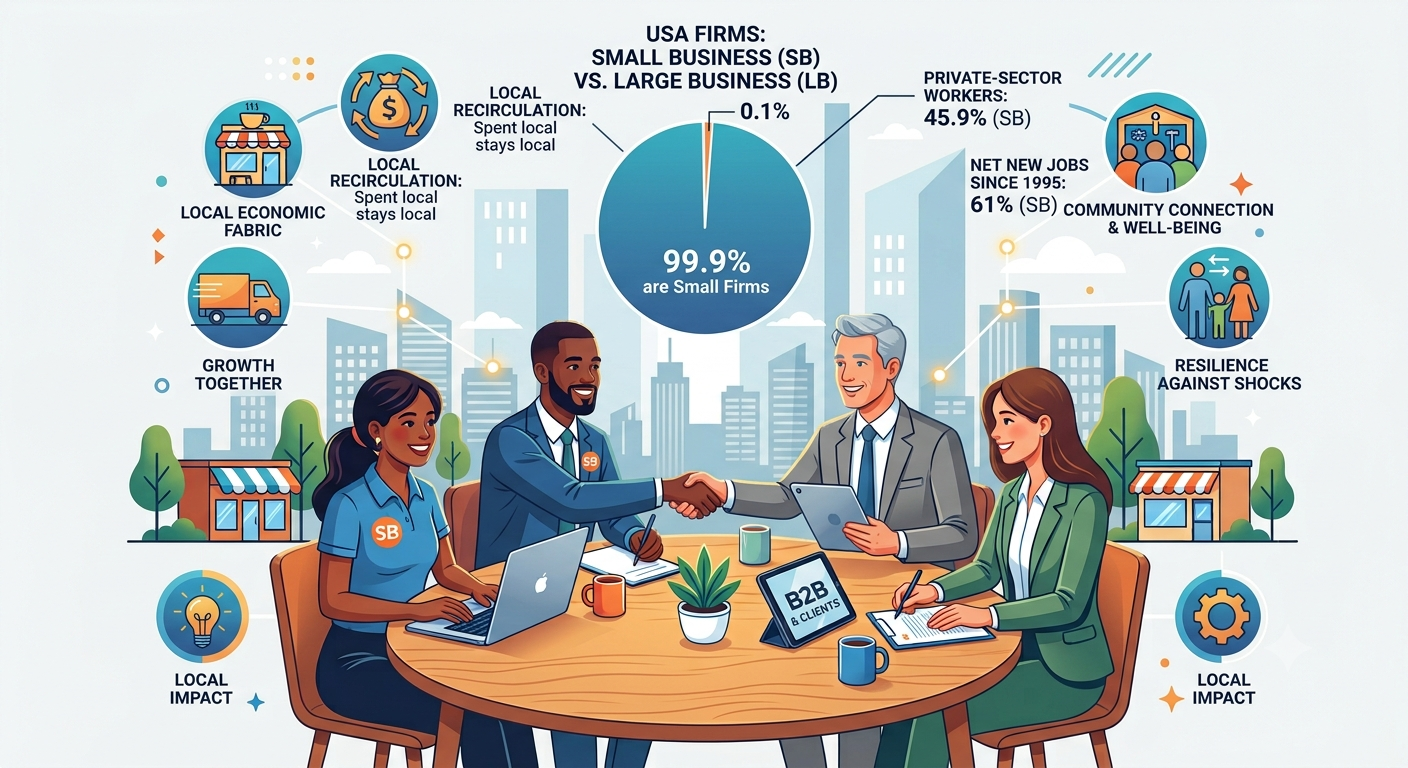
Large companies make many things cheaper, faster, and easier to find, and millions of talented people work hard every day to deliver these benefits. But small business is not some sentimental side note to the economy. In the United States, small businesses account for 99.9% of firms, employ 45.9% of private-sector workers, and have generated 61% of net new jobs since 1995.
Large businesses matter. Their scale can support lower costs on standardized products and services, expansive variety, and broader distribution. Their vast resources fuel investment in new technologies, acquisitions, and product development pipelines that can benefit entire industries. They also tend to offer better compensation and richer benefits packages than smaller employers, according to Bureau of Labor Statistics. These are real advantages.
Yet these advantages create gaps that small businesses are often uniquely positioned to fill. Scale has its tradeoffs. It’s excellent at standardizing what is common, but not always as good at solving what is specific, urgent, local, or unusual. That is where small businesses matter—and why I believe we need them, even in a world where convenience has never been easier to buy.
Innovation & Collaboration
In many industries including my own—pharma & biotechnology—large companies increasingly complement internal R&D with external innovation through partnerships, licensing, and acquisitions. IQVIA reports that emerging biopharma companies originated 85% of the 48 new active substances launched in 2024, and McKinsey notes that top pharma companies have relied heavily on external innovation over the past decade.
At my company, PBL Assay Science, we can’t match the sheer breadth of products and services that the largest life-science manufacturers and CROs offer. But we've developed products and services that outperform those of larger competitors in our specialty areas, and we remain more agile, more cost-effective, more responsive, and our key personnel are more directly accessible. Many of our clients have told us that the speed, depth of expertise, and collaborative problem-solving they get from us simply can't be replicated at larger organizations—where scheduling a conversation with a senior scientist might require weeks of lead time and layers of coordination. In these moments, the advantage is not scale; it’s speed, direct access, specialized expertise, and the ability to tailor solutions that can help speed along research and drug development projects.
Inefficient “Efficiencies”
Large organizations have the resources to invest in ambitious operational improvements, and many of those investments pay off. But size can also produce a particular kind of institutional inertia: the tendency to mistake activity for progress, and technology for improvement.
 Consider the AI-assisted phone system — a tool that, in theory, routes customers to the right help faster and reduces costs. In practice, many of us have spent far more time navigating multi-level menus, recovering from misrouted calls triggered by background noise from shuffled papers or a barking dog, and being transferred between departments than we ever would have with a straightforward human receptionist. There are no neutral, large-scale randomized studies evidencing the financial benefits of these systems, and there's credible evidence indicating that they don't always save money or any savings are overstated. The cost in customer time and goodwill, however, is rarely measured.
The contrast with a smaller organization—or even a large one that operates with a small-business mindset—can be striking. My auto insurer, New Jersey Manufacturers, is a large company, yet when I recently called them, two button presses connected me to a live agent. One more contact and five minutes later, I had exactly what I needed in my email inbox. That's not just good service — it's genuine efficiency, for the customer as well as the company.
At PBL, we take on infrastructure projects like website redesigns or new phone systems only when there's a clear, demonstrated need and a meaningful benefit for our clients and our operations. We don't redesign things because we have a design department. (In fact, we don’t have an in-house design department.) We don’t replace a phone system because a vendor promises theoretically modeled efficiencies. That discipline, born of resource constraints, results in fewer unnecessary disruptions for our staff—and more reliable experiences for the people we serve.
The Economic Case for Local
There's a straightforward economic argument for supporting small and local businesses that often goes unmentioned: money spent locally tends to stay local. Studies consistently show that a significantly higher proportion of revenue from locally owned small businesses recirculates within the community—through local suppliers, employees, and services—compared to spending at national chains, where profits largely flow elsewhere. Supporting small businesses isn't just personally satisfying; it strengthens the economic fabric of the places where we live.
There's also a resilience argument. Communities with a diverse ecosystem of small businesses are better cushioned against economic shocks. A single large employer's departure can hollow out a town; a community of varied small businesses provides distributed stability that's far harder to disrupt.
Convenience & Quality of Life
As much as I value the services that companies like Amazon, Costco, and Walmart provide—and I do—I don't want to live in a community where those are the only options. As I've grown older, I've thought more about being able to walk or bike to meet basic needs, about curtailing unnecessary driving, and about the value of being able to access a farmer's market, a tailor, a hair salon, a café, or a locally owned pub nearby. These aren't nostalgic luxuries. For aging populations in particular, the availability of nearby, walkable small businesses has real implications for health, mobility, and independence.
Community, Connection, & the Costs of Polarization
Research on workplace culture consistently finds that employees at smaller organizations—or at larger ones structured around small, tight-knit teams—report stronger senses of engagement, purpose, and connection to their colleagues. They feel like they’re part of a family. Small businesses can also be more flexible in responding to individual employee needs, a reality that matters enormously in a world where work-life balance has become a central concern for workers at every level.
Beyond the workplace, there's a broader social dimension worth considering. The shift away from local commerce toward big-box stores and online shopping has coincided with a measurable decline in daily social interaction. While that shift reflects many forces at work, the loss of the neighborhood shop—where you know the owner, where the owner knows you—may be a quiet contributor to the social fragmentation and reduced empathy that many observers have noted in recent years.
The faces at the small businesses you frequent often belong to people you come to know and trust and, in many cases, genuinely befriend. There is a certain care taken when we know the members of our communities who are serving our needs. This kind of connection isn't trivial. It's part of what makes a community feel like one.
Need for Small & Large Business Alike
None of this is an argument against large businesses or the people who build and work in them. Large companies provide essential products, employment, and economic infrastructure that no collection of small businesses could replace. The goal isn't to choose sides—it’s to be thoughtful about our choices and their consequences.
What it does mean is this: the next time you're weighing where to take your business, it's worth pausing to consider what you're supporting. Small businesses in your community and in your industry depend on that consideration to survive. The more varied the businesses we support, the more vibrant, resilient, and connected the communities we build together. Vote with your dollars—not against large businesses, but genuinely for the small ones that make your community worth living in.