 Powered by Bioz
This well-cited ELISA quantitates IFN-Beta in tissue culture media (TCM) with an LLOQ of 50 pg/ml. Recombinant Human IFN-Beta 1a expressed in mammalian cells is provided as the standard.
Product Name: VeriKine Human Interferon-Beta ELISA Kit (TCM)
This well-cited ELISA quantitates IFN-Beta in tissue culture media (TCM) with an LLOQ of 50 pg/ml. Recombinant Human IFN-Beta 1a expressed in mammalian cells is provided as the standard.
Product Name: VeriKine Human Interferon-Beta ELISA Kit (TCM)
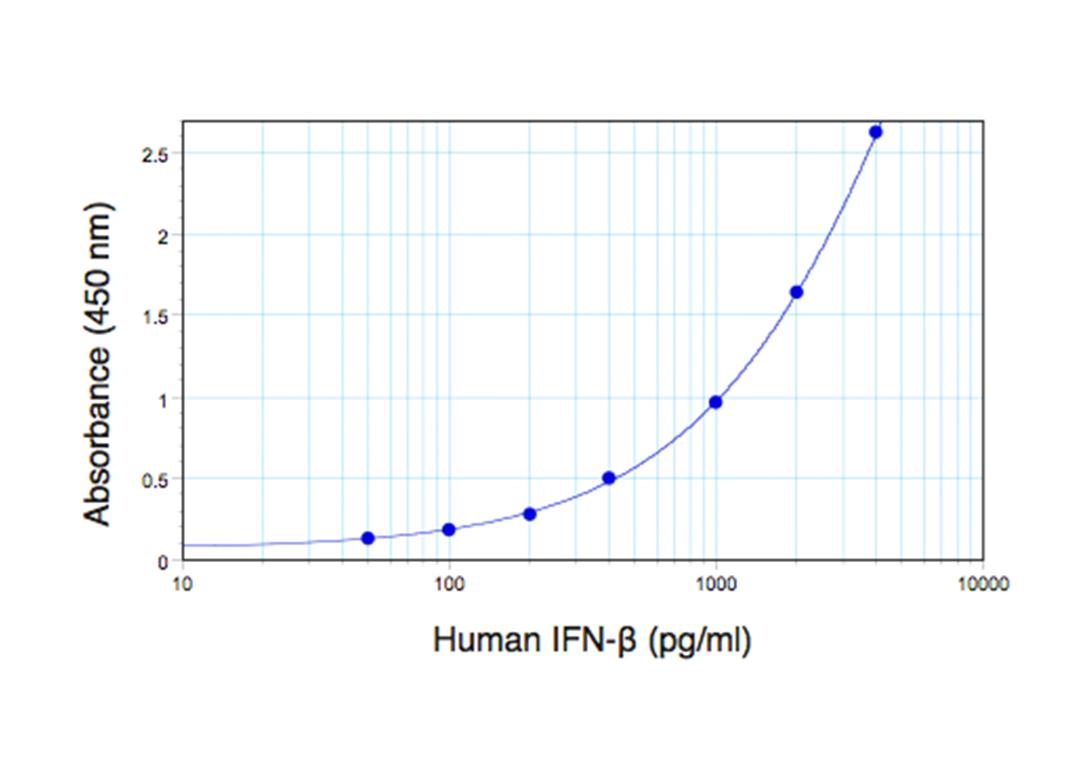
Typical Human IFN-Beta standard curve from 50 to 4000 pg/ml using PBL's Human IFN-Beta ELISA kit (41410).
| Matrix Compatibility | Tissue Culture Media |
|---|---|
| Assay Range | 50 - 4000 pg/ml |
| Assay Length | 3 hours, 15 minutes |
| Specificity | Human IFN-Beta |
The VeriKine Human IFN-Beta ELISA Kit has been developed to measure levels of Human IFN-Beta in buffers or tissue culture media (TCM) samples by sandwich enzyme-linked immunosorbent assay (ELISA). The kit is based on an ELISA with streptavidin conjugated to horseradish peroxidase (HRP). Tetramethyl-benzidine (TMB) is the substrate. The assay is based on the international reference standard for Human IFN-Beta provided by the National Institutes of Health.
*For a more sensitive TCM-compatible ELISA, we recommend our Human IFN-Beta ELISA Kit, High Sensitivity (Cat. No. 41435-1).
*For complex biological matrices such as plasma, healthy sera, and disease sera, we recommend our Human IFN-Beta Serum ELISA Kit, High Sensitivity (Cat. No. 41415-1).
Protocol, Certificate of Analysis (CoA), Safety Data Sheet (SDS)
41410-1 Certificate of Analysis (CoA) and Protocol
41410-2 Certificate of Analysis (CoA) and Protocol
41410 Protocol (Full)
41410 Safety Data Sheet
41410 Product Notice Standard Stock Change
41410 Product Notice Standard Reformulation
| CVs | Inter-Assay: ≤ 8%
|
|---|---|
| Cross-reactivity | No cross-reactivity against
|
| Synonyms | Human IFNB, Human Beta Interferon, Human Fibroblast IFN, Human IFN Beta, Human Fibroblast Interferon, Human Beta IFN, Human Type I Interferon Beta, Human IFN B |
| Storage | 2-8°C |
| Expiration Date | One year from date of manufacture |
| Shipping Condition | Wet Ice |
Following secretion, Interferon Beta binds to type I interferon receptors on proximal or distal cells activating the JAK1-STAT signaling pathway. Activation of this signal transduction pathway leads to the expression of 2’-5’ oligoadenylate synthetases (2’5’ OAS), protein kinase R (PKR), MxA proteins, and interferon regulatory factor 7 (IRF-7). The upregulation of IRF-7 expression can exert positive feedback on IFN-β production, whereas the induction of 2’5’ OAS activates a latent endonuclease known as RNase L. RNase L cleaves both viral and cellular single-stranded mRNA, thereby limiting viral replication and dissemination.
IFN-beta is present as a single gene in humans. The biological activity of IFN-beta can be functionally similar when compared to other type I IFNs, but can also exhibit distinct gene expression patterns as compared to IFN-alpha. In vitro binding studies suggest that IFN-beta binds to the Type I IFN receptor with higher affinity than the other Type I IFNs and this may regulate receptor internalization in a different manner. IFN-β has long been known to inhibit viral replication as part of the body’s innate antiviral response and it is currently used as a therapeutic for treatment of relapsing-remittent multiple sclerosis and some tumors.