 Powered by Bioz
Mouse Interferon Alpha A recombinant protein with activity > 1 x 10⁵ U/ml. This IFN-Alpha subtype is extensively used for research.
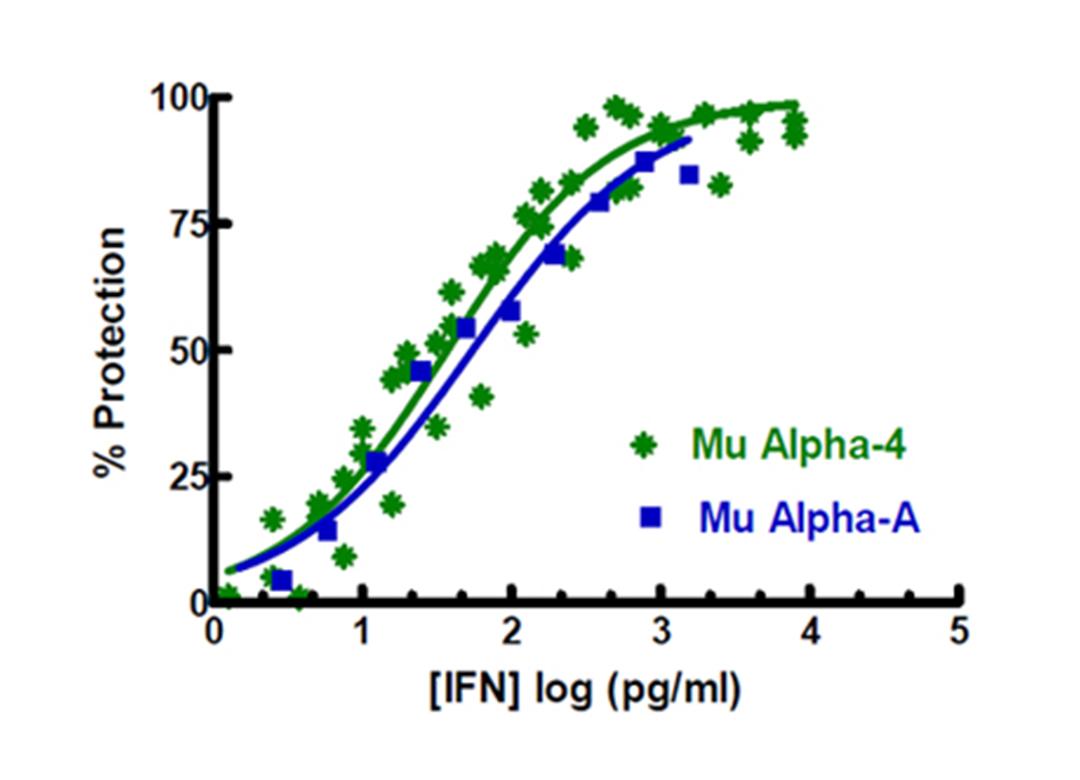
Antiviral Activities of PBL's Mouse IFN-Alpha A (12100) and Mouse IFN-Alpha 4 (12115) on Mouse L929 Cells Infected with EMCV. The activity of Mouse IFN Alpha A and Mouse IFN Alpha 4 was compared in an L929/EMCV CPE assay.
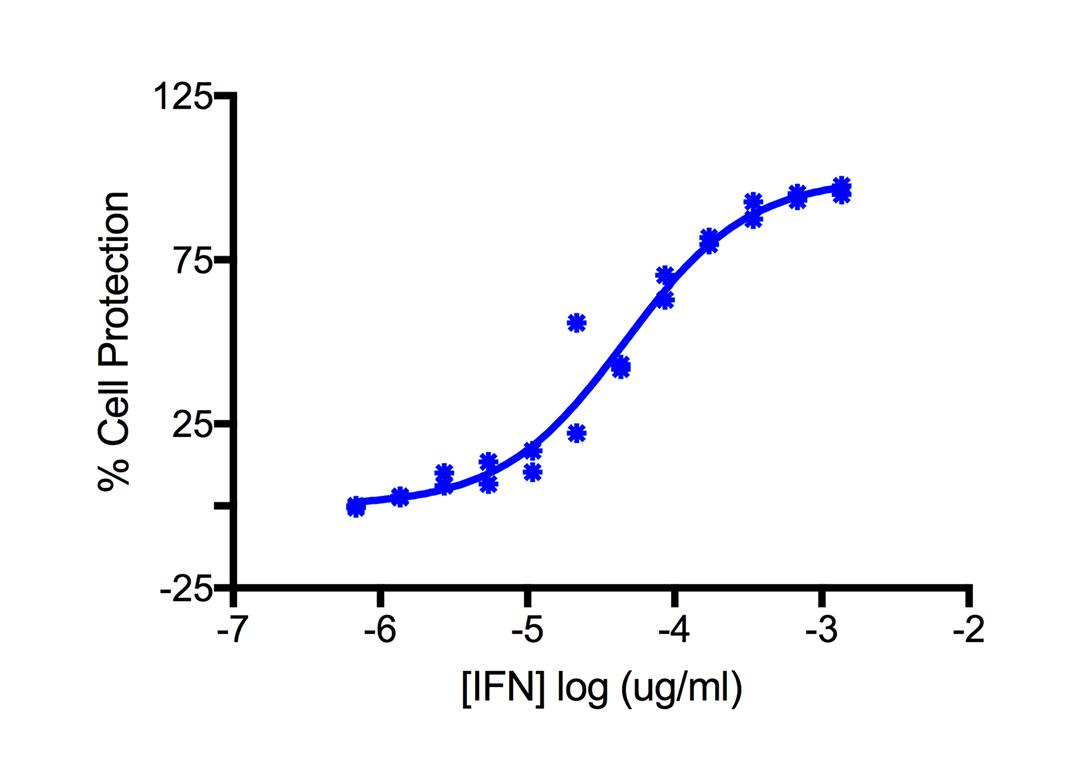
Titration of Mouse IFN-Alpha A in L929 cells.
Documentation
Certificate of Analysis (CoA) and Safety Data Sheet (SDS)
12100-1 CoA
12100-1 Certificate of Analysis
12100 SDS
12100 Safety Data Sheet
| Formulation | Supplied frozen in phosphate-buffered saline (PBS) containing 0.1% Bovine Serum Albumin (BSA) |
|---|---|
| Molecular Weight | 19.3 kDa |
| Source | cDNA obtained from mouse leukocyte interferon expressed in E.coli |
| Purity | > 95% by SDS-PAGE stained by Coomassie Blue Endotoxin level < 1 EU/μg |
| Bioactivity | Measured using a cytopathic inhibition assay on Mouse (L929) cells with EMCV. EC50 for IFN Alpha A in this assay is ~ 5 U/ml. |
| Storage | For retention of full activity store at -70°C or below and avoid repeated freeze/thaw cycles |
| Synonyms | Mouse Interferon Alpha, IFNA3, Interferon Alpha 3, IFNA, IFN-alpha A |
| Accession Number | NP_996753 |
Background
Most mammalian species have multiple IFN-Alpha subtypes. Although the reasons for these multiple subtypes are not fully known, there are clear cell type and temporal differences in their expression. A recent study established a nomenclature for the mouse IFN-Alpha subtypes (van Pesch, et al. 2004) and determined relative activities of the subtypes with protein quantification by phosphorimaging of metabolically-labeled protein. In this study, Mouse IFN-Alpha A was deemed to have average antiviral activity when compared with the potency of the other subtypes.
Mouse IFN-Alpha A was initially cloned by Daugherty, et al. (1984) J. Interferon Res. 4(4) 635]. Being the first commercially available Mouse IFN-Alpha protein, it has been used extensively in published research reports. Expression of this subtype has been observed in neurons infected with Theiler’s virus [Delhaye, et al. (2006) PNAS 103(20)7835]. Additionally, the protein has been shown to sensitize lymphocytes to undergo apoptosis [Cuerro, et al. (2004) J. Exp. Med. 200(4)535] and enhance the proliferation and differentiation of CD8 T-cells [Curtsinger, et al. (2005) J. Immunol. 174(8) 4465]. Furthermore, it was used to determine that B10.Q/J mice are susceptible to infection due to a Tyk2 mutation [Shaw, et al.(2003) PNAS 100(20)11594]. Hardy, et al. [Genomics (2004) 84:331] recently suggested a name of IFN Alpha 3 based on sequence comparison of the Mouse IFN-Alpha subtype family of proteins.
For more information on Mouse IFN-Alpha subtype nomenclature click here.