 Powered by Bioz
Often-cited E.coli-expressed Mouse IFN-Beta protein with a single non-glycosylated polypeptide chain. This protein boasts increased stability with an engineered disulfide bond.
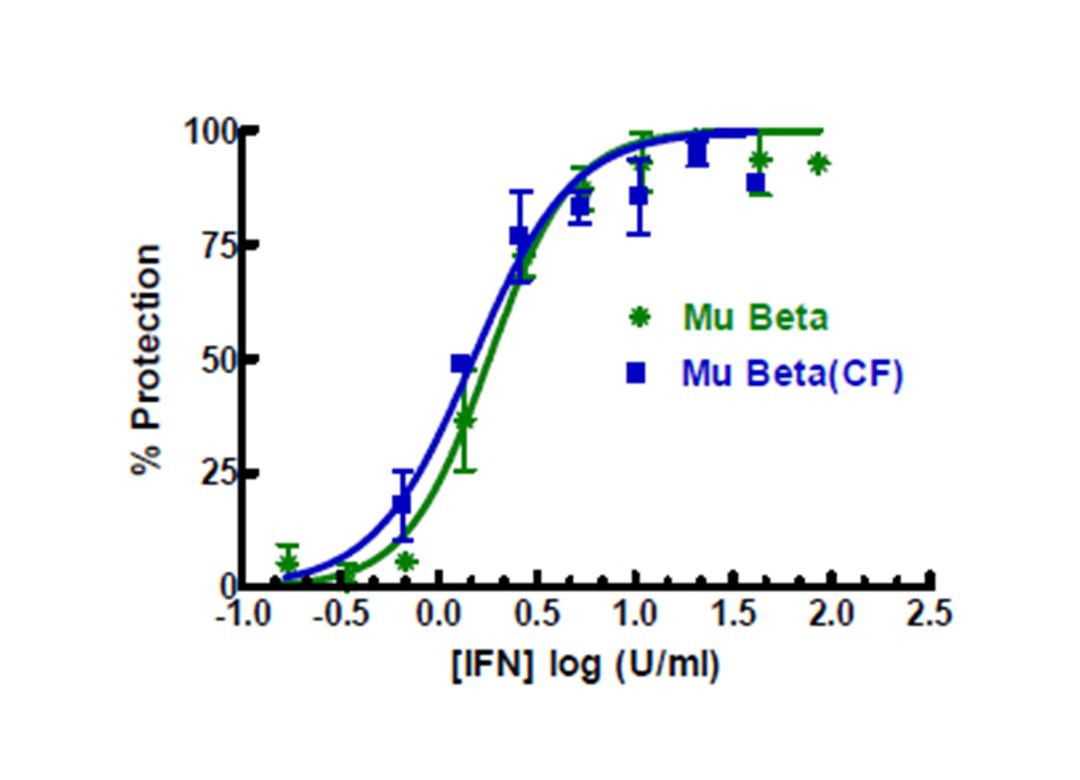
Antiviral Activities of PBL's Carrier-containing (12400) and Carrier-free Mouse IFN-Beta (12401) on Mouse L929 cells infected with EMCV
Product Info
| Bioactivity | Measured using a cytopathic effect inhibition assay on Mouse (L929) cells with EMCV. EC50 for IFNβ is ~ 2.5U/ml |
|---|
Documentation
Certificate of Analysis (CoA) and Safety Data Sheet (SDS)
12400-1 CoA
12400-1 Certificate of Analysis
12400 SDS
12400 Safety Data Sheet
| Formulation | Supplied frozen in 20mM HEPES, pH 6.0; 0.5M NaCl; 6% glycerol; 0.1% Bovine Serum Albumin (BSA) |
|---|---|
| Molecular Weight | 19.6 kDa |
| Source | Gene was obtained from mouse DNA expressed in E. coli modified as described in Day, et al. (1992) "Engineered disulfide bond greatly increases specific activity of recombinant murine interferon beta" (J. Interferon Res. 12: 139-43). |
| Purity | > 95% by SDS-PAGE stained by Coomassie Blue Endotoxin level < 1 EU/μg |
| Storage | For retention of full activity store at -70°C or below and avoid repeated freeze/thaw cycles |
| Synonyms | Mouse Beta-IFN, Mouse Beta Interferon, Mouse IFN-Beta, Mouse IFNB, Mouse Type I IFN-Beta, Mouse Fibroblast IFN, Mouse Fibroblast Interferon, Mouse Type I Interferon Beta |
Background
IFN-Beta is generally the first Type I IFN to be expressed after viral infection. In the mouse both IFN-Beta and IFN-Alpha 4 prime cells for the production of the other Type I IFNs. Mouse IFN-Beta was originally cloned by Higashi et al. [(1983) J. Biol. Chem. 258(15):9522] and has been engineered to contain a disulfide which confers added stability.