This ELISA quantitatesthe amount of IFN-Beta in tissue culture media (TCM) with an LLOQ of 2.34 pg/ml. This kit provides accurate IFN-Beta quantification withoutinterferencefrom soluble IFN receptor (sIFNAR2).
Product Name: VeriKine-HS Human Interferon-Beta TCM ELISA Kit
$665.00
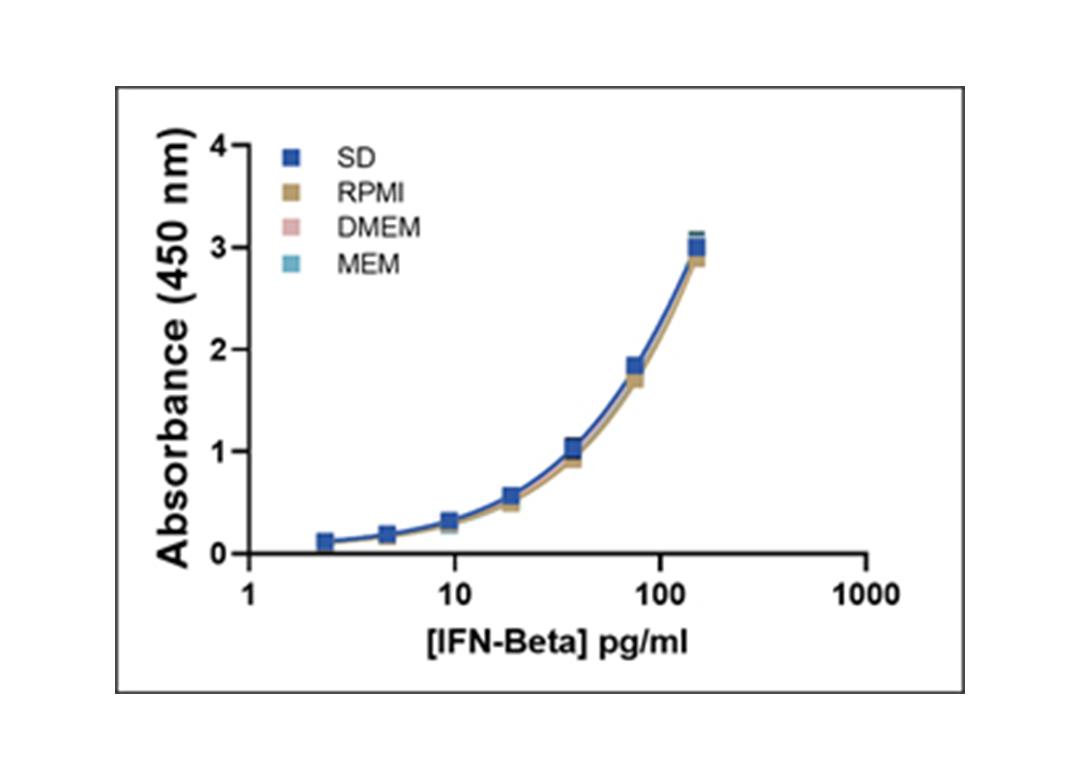
Representative Human IFN-Beta Standard Curves in Various Matrices (see Technical Data Sheet).
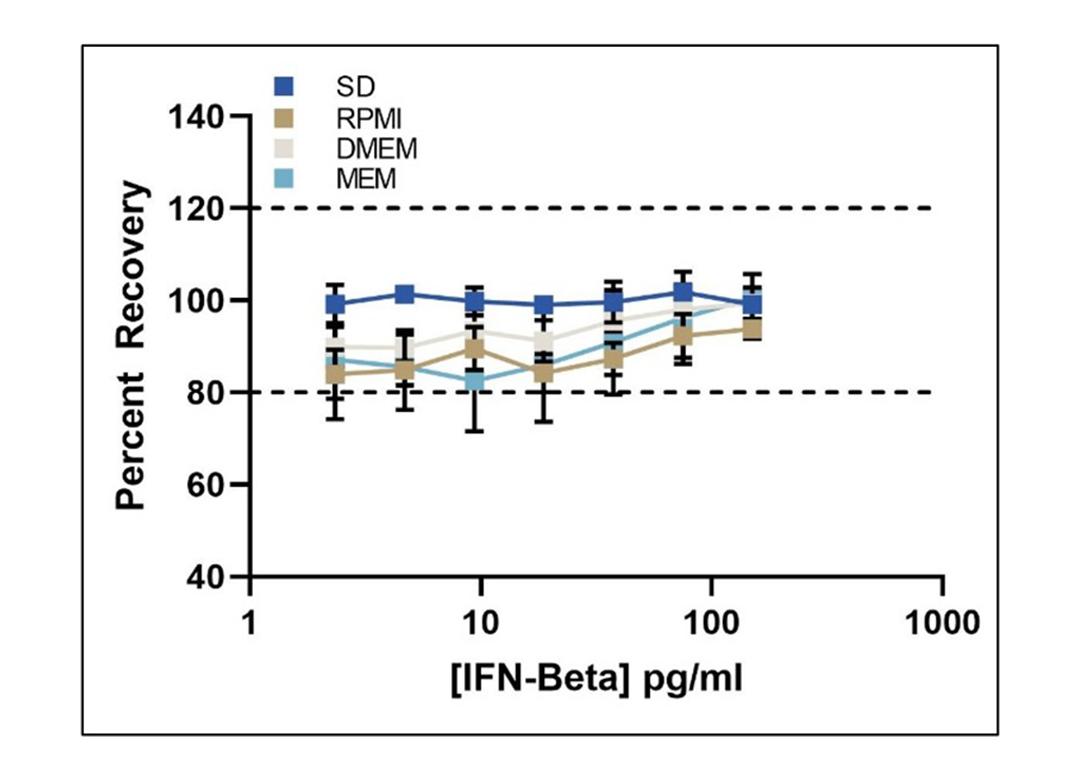
Matrix Compliance of Standard Diluent and Three Different TCMs (see Technical Data Sheet).
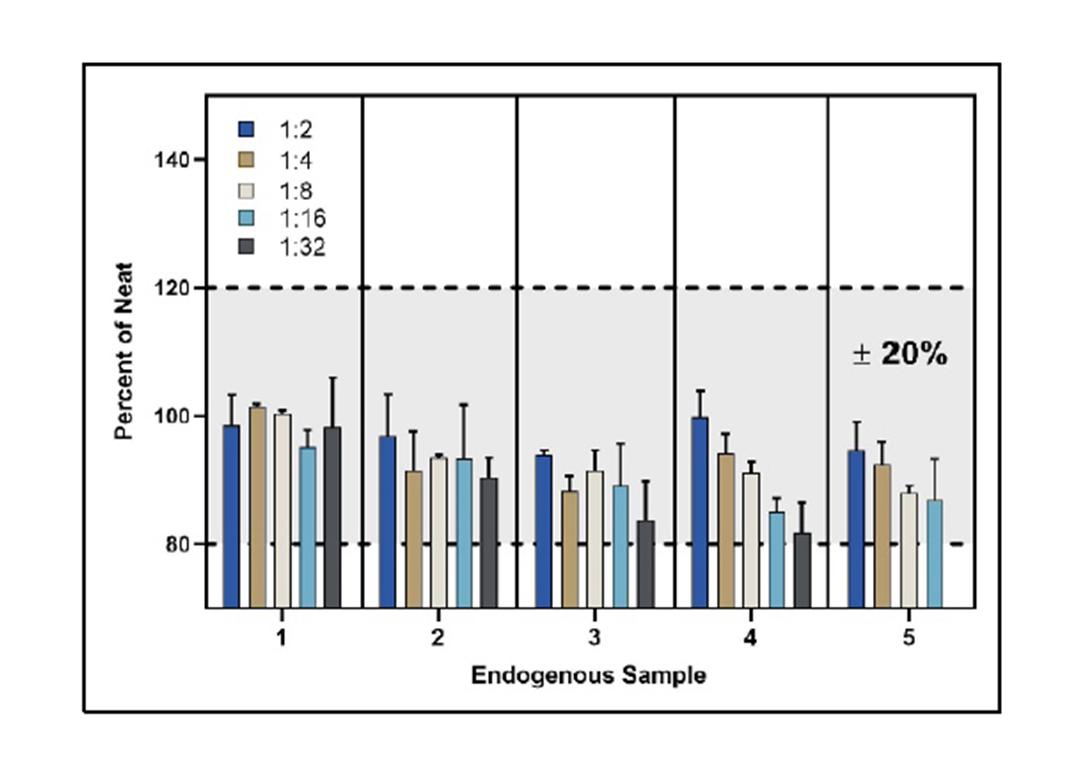
Parallelism of Endogenous Samples (see Technical Data Sheet).
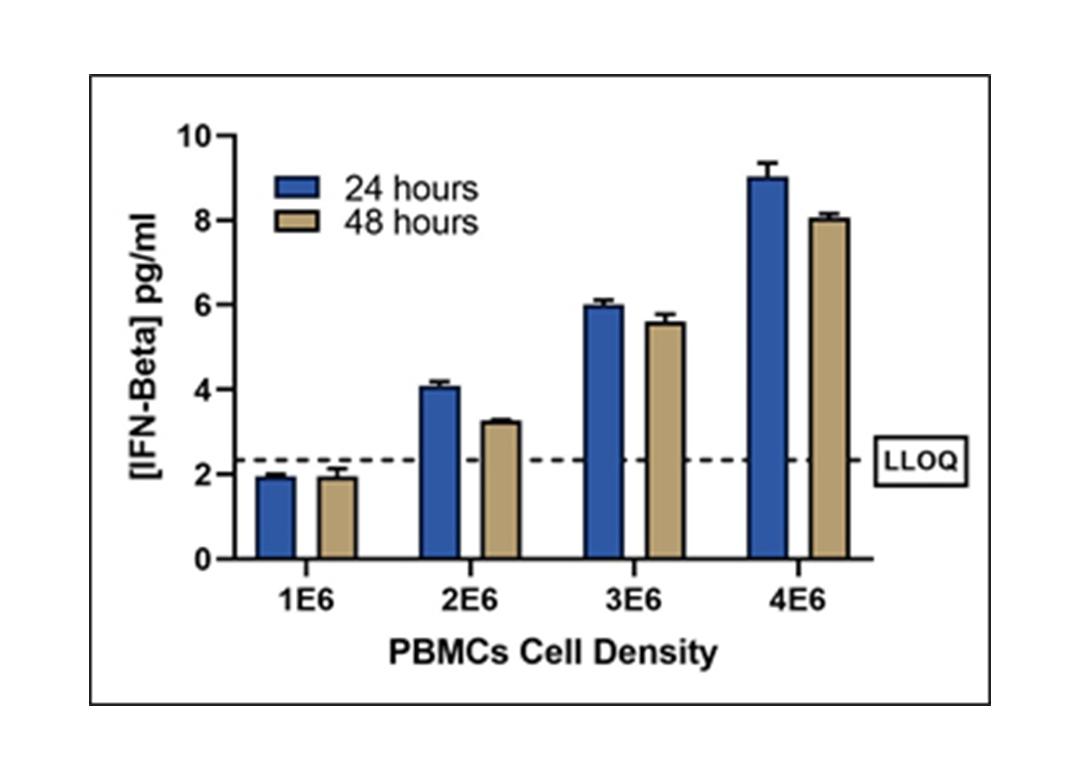
Sensitivity in Stimulated PBMC Samples (see Technical Data Sheet).
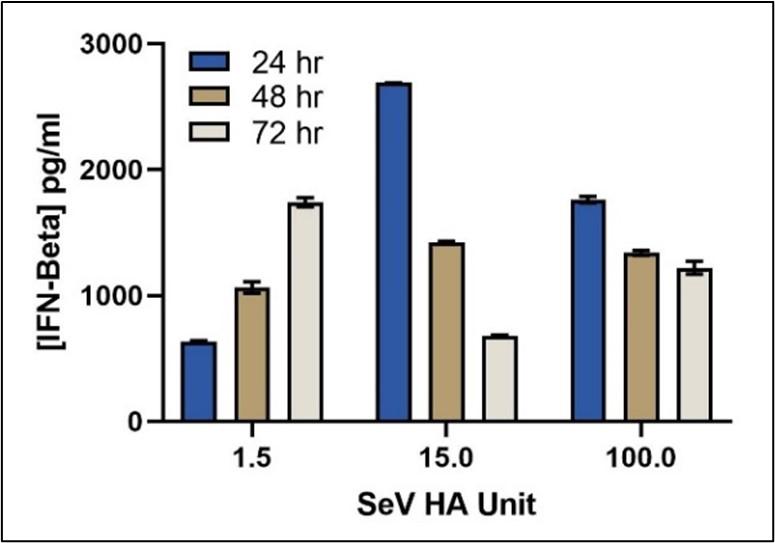
Endogenous Levels of IFN-Beta Quantified in Sendai Virus-Induced HEK293 Cells (see Technical Data Sheet).
Comparison of standard curve in the presence of sIFNAR2
sIFNAR2 Receptor Effect in PBL’s 41435 ELISA (see Technical Data Sheet for more).
sIFNAR2 Receptor Interference (see Technical Data Sheet for more).
The VeriKine-HS Human IFN-Beta TCM ELISA Kit is designed for accurate quantification of low-level human interferon beta in buffers or tissue culture media (TCM) by sandwich ELISA. The LLOQ of this kit is 2.34 pg/ml.
Note: This kit is not intended for use with human serum or plasma samples due to a significantly elevated risk of false-positive results.
Human Beta Interferon, Human Fibroblast IFN, Human Type I Interferon Beta, Human IFNb
Storage
2-8ºC
Expiration Date
12 months from the date of manufacture
Shipping Condition
Wet Ice
Materials Provided
Pre-coated microtiter plate
Plate Sealers
Wash Solution Concentrate
Human IFN Beta 1a Standard, 100,000 pg/ml
Standard Diluent
Sample Buffer
Antibody Concentrate
HRP Conjugate Concentrate
Assay Diluent
TMB Substrate
Stop Solution
Additional Materials Required (Not Provided)
Microplate reader capable of reading an OD at a wavelength of 450 nm
Variable volume microtiter pipettes
Adjustable multichannel pipette (50-300 μl)
Reagent reservoirs
Wash bottle or plate washing system
Distilled or deionized water
Serological pipettes (1, 5, 10 or 25 ml)
Disposable pipette tips (polypropylene)
Plate shaker
Representative Human IFN-Beta Standard Curves in Various Matrices
Human IFN-Beta standard curves were prepared in Tissue Culture Media (TCM) and Standard Diluent (SD). Three different TCM were used: RPMI, DMEM and MEM. TCM were supplemented with 10% FBS. This figure shows the mean of two runs and error bars indicate the standard deviation.
Intra and Inter-Assay CVs to measure Precision
Matrix
Standard Diluent
TCM
n
7
18
Intra-Assay CV (%)
4.10
4.06
Inter-Assay CV (%)
2.33
3.16
Spike Recovery
TC Media Spike Sample
1
2
3
Target Conc. (pg/ml)
100
25
5
Mean Recovery (%)
101.1
95.7
91.4
Range (%)
97-106
90-102
85-96
Matrix Compliance for Standard Diluent and Three Different TCM
Human IFN-Beta standard curves were prepared in Tissue Culture Media (TCM) and Standard Diluent (SD). Three different TCM were used: RPMI, DMEM and MEM, each supplemented with 10% FBS. The figure below shows the recovery of Human IFN-Beta Standard at the different concentrations for the various matrices. The SD curve was used as reference for calculating the percent recovery of IFN-Beta in TCM from the expected value. The figure shows the means of two runs, and error bars indicate the standard deviation.
Parallelism of Five Endogenous Samples
Five endogenous samples were tested and assayed in duplicate. Samples were serially diluted in TCM to the 32-fold dilution, which still lies within standard curve range. Percent recoveries are 100 ± 20% of neat value except for the 32nd dilution of Sample 5 (S5) which falls just beneath the bottom standard curve point of 2.34 pg/ml. Error bars indicate the standard deviation.
Sensitivity in Stimulated PBMC Samples
PBMCs were isolated from a healthy individual’s buffy coat and stimulated with 10 ug/ml of the TLR-7/8 agonist, R-848, to induce detectable levels of IFN-Beta in RPMI. Four densities of PBMCs were used (1E6, 2E6, 3E6 and 4E6 cells per ml), and supernatants were collected 24 and 48 hr post stimulation. The 1E6 PBMC samples fall below the LLOQ (Lower Limit of Quantitation) of 2.34 pg/ml.
Endogenous Levels of IFN-Beta Quantified in Sendai Virus-Induced HEK293 Cells
HEK293 cells were infected with 1.5, 15 and 100 HA units of Sendai Virus (SeV). Supernatants were collected at four time points post-infection (6, 24, 48 and 72 hr). The 6 hr time point is not shown. Due to high expected IFN-Beta levels, samples were diluted 1:100 in TCM. Each uninfected control was assayed and added neat on the plate. All uninfected samples (negative controls) yielded OD values similar to the plate blank of 0.05 indicating no quantifiable IFN-Beta (data not shown). The standard curves and samples were run in duplicate. Sample concentrations were interpolated from the assay calibrator. Error bars indicate standard deviation.
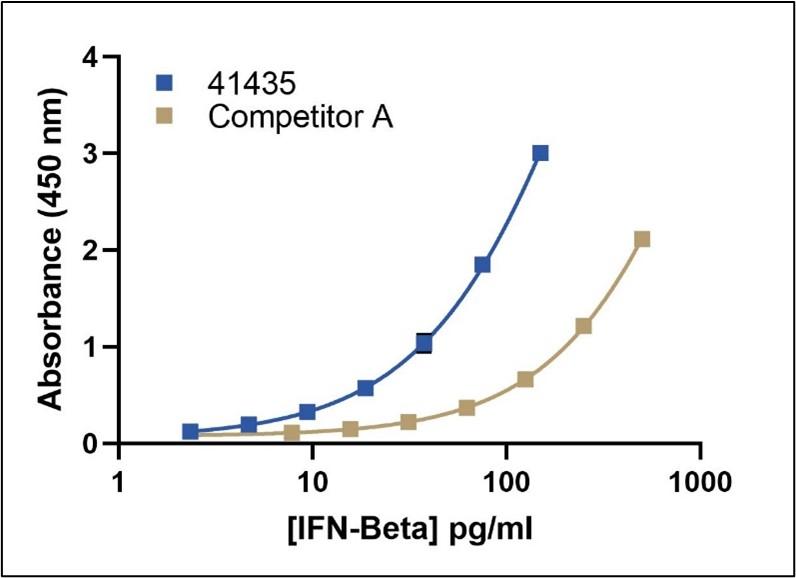
Representative Standard Curves
Competitor A’s immunoassay standard curve showcases less sensitivity than PBL’s 41435.
sIFNAR2 Receptor Interference in Competitor A’s ELISA
To test whether soluble Interferon Alpha/Beta Receptor 2 (sIFNAR2) interferes with the detection of IFN-Beta in Competitor A’s ELISA, various concentrations of IFN-Beta standard were pre-incubated with and without 10 ug/ml of active sIFNAR2 in Calibrator Diluent (CD). Standards were assayed in duplicate. 0.1% BSA was added as a carrier protein to the Calibrator Diluent with and without sIFNAR2. Data was generated from three runs.
sIFNAR2 Receptor Interference in Competitor A’s ELISA
The recovery of Human IFN-Beta Standard is shown at different concentrations in Calibrator Diluent (CD) both with and without sIFNAR2. The CD+BSA curve was used as reference for calculating the percent recovery of IFN-Beta in CD+BSA+sIFNAR2 vs the expected value. Data was generated from three runs. Error bars indicate the standard deviation. Incubation with 10 ug/ml of active sIFNAR2 elicited 80% suppression of the detection of IFN-Beta in Competitor A’s ELISA.
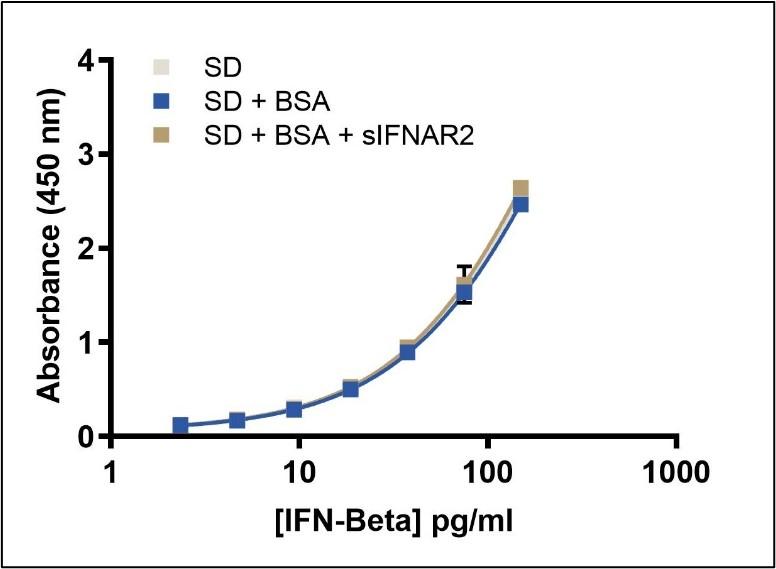
sIFNAR2 Receptor Effect in PBL’s 41435 ELISA
To test whether sIFNAR2 interferes with the detection of IFN-Beta in the 41435 ELISA, various concentrations of IFN-Beta standard were pre-incubated with and without 10 ug/ml of active sIFNAR2. Standards were assayed in duplicate, without 0.1% BSA, in Standard Diluent (SD). 0.1% BSA was added as a carrier protein to the Standard Diluent with and without sIFNAR2. Data was generated from a single run and demonstrates a lack of sIFNAR2 receptor interference.
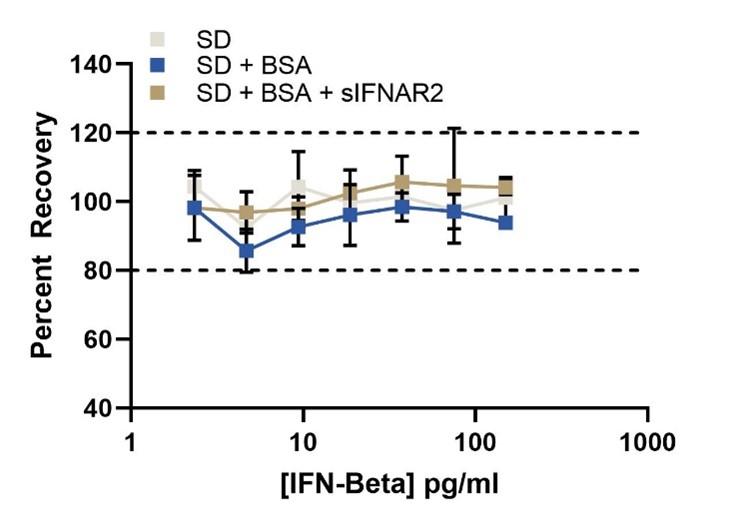
Quantitation of Total IFN-Beta in the presence of sIFNAR2
The recovery of Human IFN-Beta Standard is shown at different concentrations in Standard Diluent (SD) both with and without sIFNAR2, and without 0.1% BSA. The SD curve was used as reference for calculating the percent recovery of IFN-Beta in SD+BSA+sIFNAR2 and SD+BSA vs the expected value. Recoveries of the SD+BSA+ sIFNAR2 curve based on the backfit of SD+BSA curve were similar to recoveries in SD without BSA. Detection of IFN-Beta was neither enhanced nor inhibited by sIFNAR2 at 10 ug/ml. The 41435 ELISA detects free IFN-Beta as well as IFN-Beta bound to soluble IFNAR2 receptors and therefore quantifies a measure of total IFN-Beta. Data was generated from a single run. Error bars indicate the standard deviation.
Background
Interferon Beta (IFN-Beta, IFNb) is synthesized and secreted by fibroblasts and many other cell types in response to varied stimuli in Toll-like receptor (TLR) dependent and independent mechanisms. Pathogen exposure can result in the activation of transcription factors interferon regulatory factor 3 (IRF3) and NF-kB resulting in IFN-Beta production in a stimuli and cell-dependent manner. Conversely, IFN-Beta aberrant expression may be associated with inflammation and autoimmunity.
This Human IFN-Beta ELISA measures interferon beta levels in human serum, plasma, and tissue culture samples with 1.2 pg/ml LLOQ sensitivity. This kit has been validated for the measurement of IFN-Beta in autoimmune serum and of trademarked IFN-Beta 1a and IFN-Beta 1b therapeutic…
This well-cited ELISA quantitates IFN-Beta in tissue culture media (TCM) with an LLOQ of 50 pg/ml. Recombinant Human IFN-Beta 1a expressed in mammalian cells is provided as the standard.
Product Name: VeriKine Human Interferon-Beta ELISA Kit (TCM)
 Powered by Bioz